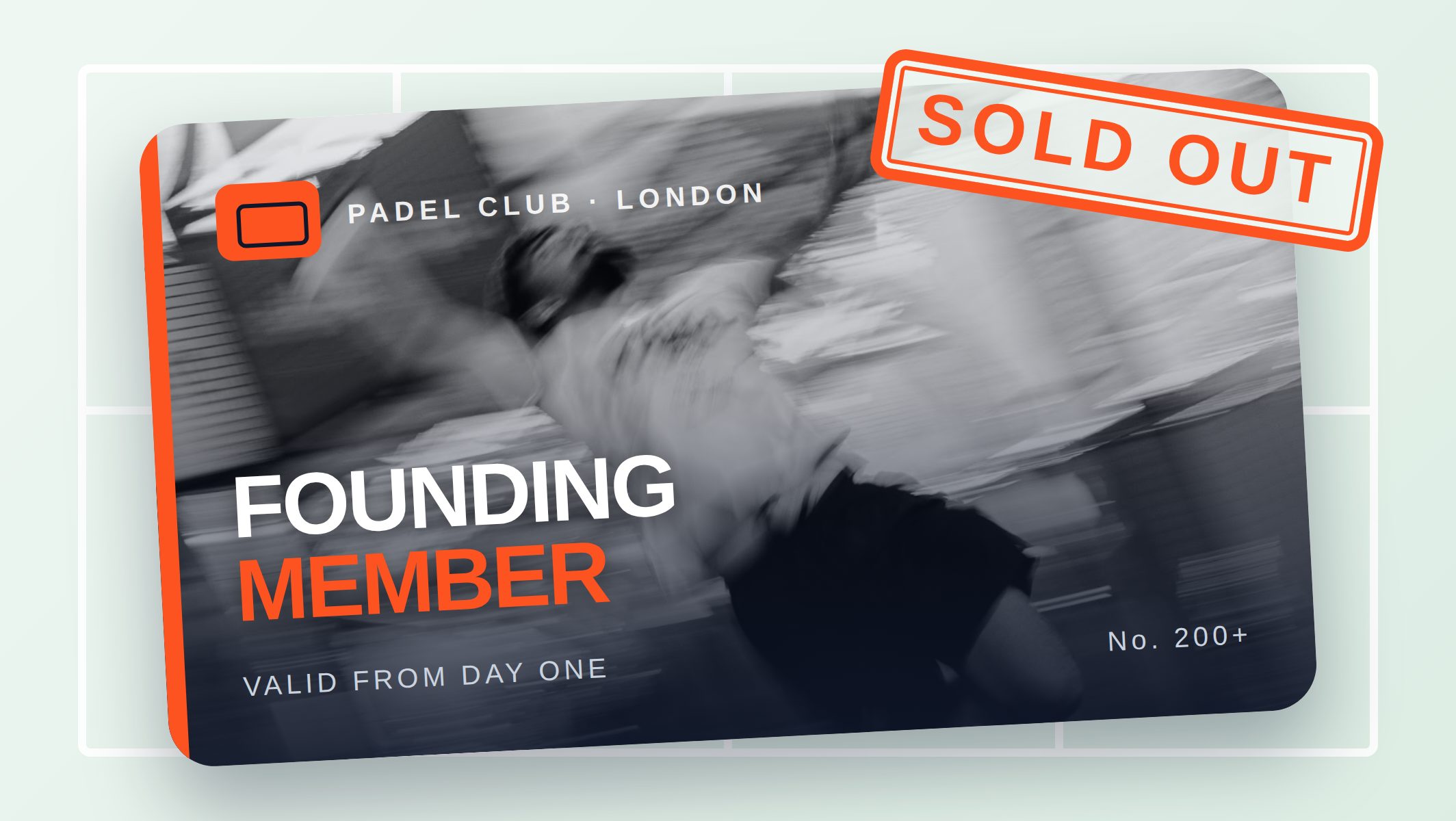
How two padel clubs turned memberships into cash for operating costs, before court revenue arrived. One in central London. One in a town of 40,000 people. Client names are withheld under NDA; the numbers are real.
The problem every new club has
The build is paid. The team is hired. Rent, salaries and electricity start on day one. Court revenue does not. It takes months for a new club to fill its evenings, and until then the club runs on the owner's savings or on a loan.
Most clubs accept this as normal. Some do not.
Case 1: central London
A padel club in central London opened its own branded app, powered by SmashClub, next to the booking platform it already used. Before the courts were ready, it offered a limited number of founding memberships, paid annually.
In the first month after launch, more than 200 players paid. Over £150,000 went straight into the club's own Stripe account. Then the club closed sales. Not because demand stopped, but because the founders' places were gone.
All of it happened before the first court was booked.
Why it worked
- A fixed number. Founding memberships were limited. A limit is what makes people pay today instead of next month.
- A price with a story. The founding price was set at roughly 16 hours of court time, not as a discount. Members were buying a place in the club, not cheaper games.
- Real founder benefits. Early access to courts and events, points and rewards in the app, a status other players can see.
- The club's own app. Players joined and paid in the club's branded app. The club set the price, the benefits and the moment to stop.
Case 2: same mechanic, small town
Central London is not a typical market. So here is the other end of the scale: a six-court club in Paphos, Cyprus, a town of about 40,000 people, where a court hour costs around €27.
Eight months after launching its SmashClub app, the club has 200 members: 120 on paid plans, from €120 a year, some at €400, and 80 on a free plan that keeps them inside the club's app and rewards.
Paid annually, in advance. The club collects the year's membership money up front and spends it on operations while the season builds. The free plan is not a loss: it is the list the club sells the next upgrade to.
What a club gets from memberships
Cash before revenue
Court bookings pay you after the game. Memberships pay you before it. For a new club that difference covers the first months of rent and salaries. For an open club it covers the slow season.
Both clubs kept their booking platform. SmashClub runs alongside it.
The math for your city
Two real clubs give two real ratios. London: about 45 founding members per court, at a price of about 16 court hours. Paphos: 20 paying members per court, at about 4.5 court hours. We put a six-court club in seven markets and applied both ratios, plus a middle target of 30 members per court at 10 court hours. Court prices are 90-day averages from public booking data, September 2026.
| Market | Court price | ConservativePaphos ratios | Target30 per court | Strong launchLondon ratios | |
|---|---|---|---|---|---|
| Paris | €48/h | €26k | €86k | €206k | |
| Dubai | €48/h | €26k | €86k | €206k | |
| Manchester area | €38/h | €21k | €69k | €165k | |
| Limassol | €36/h | €19k | €65k | €155k | |
| Berlin | €33/h | €18k | €60k | €144k | |
| Paphos | €27/h | €15k | €49k | €117k | |
| Madrid | €16/h | €9k | €29k | €70k |
Cash collected up front for a six-court club, rounded. Formula: members per court × courts × court hours × local court price. The conservative column is exactly what the Paphos club did. Even in Madrid, the cheapest padel market in Europe, the target scenario brings close to €30,000 before the first booking. Dubai court prices sit at London's level, so the London math applies there almost one to one.
What the club needs
- A launch date 6 to 10 weeks away, or an open club with a quiet season ahead
- A fixed number of founding places and a short list of real benefits
- A Stripe account. The money goes to the club, not to us
- Its booking platform, unchanged
What SmashClub does
- Branded club app and web portal, set up in 1 to 2 working days
- Membership plans, joining fees, family plans and renewals via Stripe
- Points, rewards, early access and member-only events
- Works alongside Playtomic and other booking systems
Take it with you
The same case study as a two-page PDF, for your partners, investors or the bank.